

What is LOFAR-BG?
The state-of-the-art LOFAR telescope is unique in its ability both to observe large portions of the sky and to study a wide range of astrophysical phenomena, unlike traditional optical telescopes. Another distinctive feature of LOFAR observations is the enormous volume of generated data — approximately 3 Gb/s per station. This represents both a challenge and an opportunity for the development of new technologies for processing, storage, and analysis of Big Data observations.
For more detailed information about LOFAR, we encourage you to visit the official LOFAR website.
At present, there are 40 LOFAR stations in the Netherlands and 13 additional stations across Europe. Two more stations are currently under construction — in Latvia and Italy. LOFAR-BG will be the first station in Southeastern Europe. Moreover, its large distance from the other stations will allow the telescope to significantly increase its angular resolution.
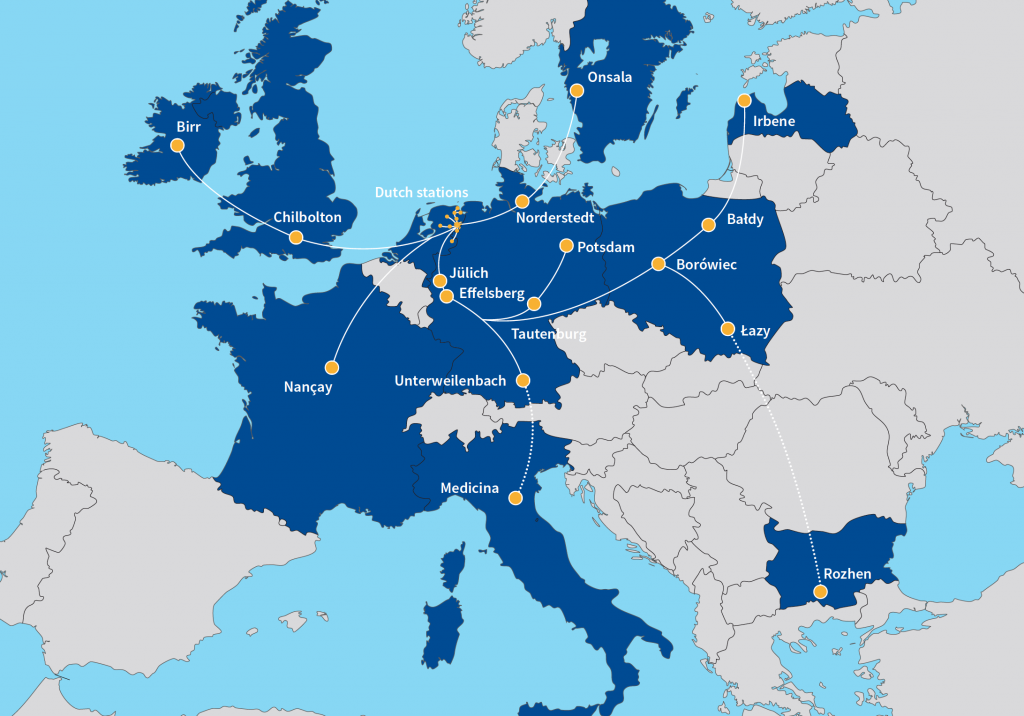
The establishment of a Bulgarian LOFAR station and participation in the LOFAR network will provide an excellent opportunity for Bulgarian scientists and students to advance their research and complement their high-quality optical studies with cutting-edge radio observations. This unique infrastructure will foster international collaboration, strengthen national scientific expertise in the field, and promote the transfer of high-tech knowledge to industry.
Building a LOFAR station in Bulgaria will enable Bulgarian researchers to participate in studies of the Epoch of Reionization in the early Universe, investigations of transient and distant extragalactic radio sources, solar physics, space weather, and cosmic magnetism. In geophysics, it will support research on cosmic rays, ionospheric dynamics, seismic activity, and lightning physics. This will create opportunities for participation in international research projects and publications, for the completion of doctoral degrees in these fields, and for the overall advancement of astrophysics and geophysics in Bulgaria.
LOFAR-BG – Part of the National Roadmap for Research Infrastructure 2020–2027
In May 2020, the infrastructure project LOFAR-BG, coordinated by the Institute of Astronomy and National Astronomical Observatory (IANAO), was approved for inclusion in the updated National Roadmap for Scientific Infrastructure 2020–2027 (NRSI), created and supported by the Ministry of Education and Science of Bulgaria.
At present, the national consortium managing the project also includes the Department of Astronomy at Sofia University St. Kliment Ohridski, the Department of Astronomy at Konstantin Preslavsky University of Shumen, as well as the Department of Radio Communications and Video Technologies at the Technical University of Sofia. In the future, we will be adding new partners to the consortium.
The project envisions the construction and development of a Bulgarian LOFAR observing station over the next 13 years, along with the establishment of strong national scientific expertise for conducting specialized astrophysical and geophysical research using both the Bulgarian station and the full LOFAR network.
In addition, the project will contribute to the development of scientific and engineering capacity, including the provision of hardware and software support for the telescope, the processing and storage of petabyte-scale observational data, as well as automated analysis using AI-based systems. The project foresees active cooperation and exchange of know-how with other scientific institutions and the industry, as well as dissemination and communication of the radio astronomy research conducted with the station.
Scientific Objectives of LOFAR-BG
Through its research activities, the Bulgarian astronomical community covers all major areas of modern astronomy and astrophysics. Establishing a LOFAR station in Bulgaria would be highly beneficial in many respects. It would raise the country’s profile on the global scientific stage and open doors to further international partnerships and collaborations. Bulgarian researchers would be able to use data obtained through LOFAR radio observations to expand and complement their ongoing studies.
As a station forming part of an interferometric array of antennas, LOFAR-BG will perform tasks identical to those of the other stations across Europe and will operate in coordination with them. This means that researchers wishing to use LOFAR observing time may apply through the procedures established by ASTRON, or rely on the observing days allocated to LOFAR-BG for independent national use.
LOFAR research is organized within the so-called Key Science Projects (KSPs), which unite scientific teams around major research topics. These include The Epoch of Reionization in the Early Universe, Surveys of the Radio Sky, Transient Sources, Solar and Space Weather Science, and Cosmic Magnetism. Scientists from all countries operating LOFAR stations have the opportunity to actively participate in these projects with their own research programs and observing proposals.
Bulgaria has a long tradition of observations in the optical range, primarily conducted at the largest scientific complex in the Balkans — the National Astronomical Observatory Rozhen. More recently, this work has also been supported by the automated 35-cm telescope at the Plana Student Astronomical Observatory operated by the Department of Astronomy at Sofia University “St. Kliment Ohridski”. As mentioned above, Bulgarian astronomers are active across all areas of space science; therefore, the broad range of astrophysical research topics accessible to a low-frequency radio observatory such as LOFAR will provide significant opportunities for further advancement of Bulgarian astronomy.
Some of the most strongly represented scientific topics in Bulgaria fall within several Key Science Projects — particularly Transient Sources, Solar and Space Weather Science, as well as Surveys of the Radio Sky.
Transient Sources
A large fraction of cosmic objects in the Universe are variable in one way or another, often on short timescales — including symbiotic stars, various types of active galactic nuclei, X-ray binaries, and others. The study of such objects is of strong interest to many astronomers in Bulgaria because of the challenges that the physics of these systems presents to scientists.
By monitoring this type of object with optical telescopes, we uncover many of their secrets. However, a significant portion of their emission remains inaccessible to Bulgarian astronomers. LOFAR offers an excellent opportunity for Bulgaria to become an active participant in radio observations of variable sources — objects that already attract considerable interest within the national scientific community.
The substantial scientific output published in leading journals and in collaboration with international teams demonstrates that Bulgaria is well prepared to operate such a facility and to fully exploit its scientific potential.
Solar and Space Weather Science
A large fraction of solar emission occurs in the radio range and, when observed at these wavelengths, it can reveal activity even when the Sun appears quiet in the optical or other parts of the electromagnetic spectrum. This, combined with energetic particles produced during high-energy events, is of fundamental importance.
Future astronauts on missions to Mars — and one day even farther — will be continuously exposed to cosmic particles. If we want these explorers to survive in interplanetary space, we must deepen our understanding of our star, its influence, and its interaction with the surrounding space environment. The physics governing solar processes is critically important because of its direct impact on interplanetary space, Earth, and human activity.
Two main institutions in Bulgaria are engaged in research on space weather and the influence of the Sun on the Solar System — the Institute of Astronomy with National Astronomical Observatory and the Institute of Space Research and Technology, both part of the Bulgarian Academy of Sciences.
LOFAR-BG will provide greater independence and flexibility for Bulgarian physicists and astronomers, enabling them to define their own observing programs and scientific priorities. This, in turn, will enhance their research productivity. In this way, Bulgaria will become a direct contributor to one of the most advanced areas of space science, with tangible implications for society.
Surveys of the Radio Sky
The formation of galaxies, star clusters, diffuse clouds, star formation, and black holes are just some of the topics that engage Bulgarian researchers and for which LOFAR would be highly valuable. Optical observations alone cannot answer all the questions we pose in this area of astronomy, and access to a radio telescope would significantly strengthen the competitiveness of the Bulgarian scientific community.
LOFAR’s operation at low frequencies, combined with its wide field of view, makes it particularly well suited for large-scale radio surveys of the sky.
Of course, these are not the only scientific interests of Bulgarian astronomers, but rather some of the most prominent areas of research. The establishment of a LOFAR station in Bulgaria will undoubtedly stimulate greater interest in radio astronomy among young scientists and attract researchers from diverse fields to new and challenging Key Science Projects.
Contribution of LOFAR-BG to Science at the National and European Level
The State of Science in Bulgaria
Science is inherently international, and its development should be assessed on the basis of internationally recognized indicators. According to the most authoritative database — Web of Science (WoS) — over the past decades Bulgaria has steadily and continuously lost positions in terms of the number of internationally visible scientific publications. From 35th place in 1990, the country moved to 44th place in 2000, and as a member of the European Union reached 51st place in 2007 and 59th place in 2016. A similar trend is observed in citation rankings, which are closely linked to the quality and impact of scientific research.
The strengths of scientific research in Bulgaria are primarily linked to its human scientific potential. Despite chronic underfunding, several strong research centers and scientific groups continue to operate both in research institutions and in universities. Bulgarian scientists remain among the leading contributors in a number of traditionally strong fields which, according to the number of publications indexed in Web of Science over the past five years, include applied physics, applied mathematics, physical chemistry, particle and field physics, astronomy and astrophysics, optics, interdisciplinary physics, nuclear physics, and others. In addition, strong research groups in various areas of the social sciences are active across universities and research organizations. This potential must be preserved and used as a foundation for the further development of scientific research in the country.
Bulgarian Science and LOFAR
By joining the international LOFAR telescope, Bulgaria takes a significant step toward strengthening its role in global astronomy and science. Establishing a station on Bulgarian territory will connect the country to a state-of-the-art network of radio telescopes with the potential to fundamentally transform our understanding of the Universe. Through LOFAR, we will be able to obtain world-class scientific observations while simultaneously training the next generation of researchers to work with them. Membership will benefit scholars across a broad range of disciplines and technologies — from astrophysics to information technology.
Until now, radio astronomy in Bulgaria has developed primarily on the basis of data from foreign research facilities. Together with the National Astronomical Observatory Rozhen, LOFAR will position the country among the leading centers for astronomical capability in Eastern Europe. It will broaden the horizons of Bulgarian scientists and stimulate new lines of research. It will also attract students from diverse fields — including astrophysics, geophysics, mathematics, and IT.
LOFAR will secure Bulgaria a place among the world’s leading countries in data analysis. The software and data-processing skills that young researchers will acquire through working with LOFAR are in high demand in industry and will open up a wide range of professional opportunities. Researchers in Bulgaria will be able to participate in international studies addressing fundamental questions about the origin and structure of the Universe. Membership in LOFAR will also strengthen youth engagement with science and inspire future generations of researchers.
One of the main strategic goals of the project is to support the development of science in Bulgaria and to help transform it into a driving force for a knowledge-based and innovation-driven economy.
Europe and the Bulgarian LOFAR Station
Bulgaria’s new partnership with the other members of the International LOFAR Telescope (ILT) will strengthen collaboration in radio astronomy across Europe. By extending its reach to the Balkans, ILT will gain its longest baseline to date, enhancing image quality for astronomers worldwide.
Until now, ILT has extended over greater distances in the east–west direction than north–south across Europe. Bulgaria’s participation represents a major step toward balancing and expanding this network, enabling baselines of up to approximately 2,500 km. This will lead to improved UV plane coverage and, consequently, higher-quality imaging. The achieved angular resolutions for baselines of 1,000 km and 2,500 km are presented in the table below.
In addition to achieving sub-arcsecond resolution, ILT will also gain improved visibility of objects located farther south on the celestial sphere.
| Frequency [MHz] | Wavelength [m] | Angular resolution [″] | |
|---|---|---|---|
| L = 1000 km | L = 2500 km | ||
| 15 | 20.00 | 3.30 | 1.32 |
| 30 | 10.00 | 1.65 | 0.66 |
| 45 | 6.67 | 1.10 | 0.44 |
| 60 | 5.00 | 0.83 | 0.33 |
| 75 | 4.00 | 0.66 | 0.26 |
| 120 | 2.50 | 0.41 | 0.17 |
| 150 | 2.00 | 0.33 | 0.13 |
| 180 | 1.67 | 0.28 | 0.11 |
| 200 | 1.50 | 0.25 | 0.10 |
| 210 | 1.43 | 0.24 | 0.09 |
| 240 | 1.25 | 0.21 | 0.08 |
It is important to emphasize that the currently operating stations of LOFAR are located mainly in Northern and Northwestern Europe. LOFAR-BG is emerging as the most distant station from the core cluster in the Netherlands and will become both the southernmost and the easternmost observing point in the network. Such a facility will benefit not only Bulgaria and Bulgarian astronomers in particular, but also the entire European scientific community, of which Bulgaria is an integral part. Through LOFAR, our scientists will have the opportunity to become direct participants in the latest astronomical discoveries, alongside countries such as Germany, the United Kingdom, France, the Netherlands, Sweden, and others.
By harnessing the outstanding human scientific potential of Bulgarian researchers, the implementation of projects such as LOFAR-BG will provide a strong boost to science at the national level and demonstrate that Bulgaria can stand alongside the leaders in radio astronomy research. The establishment of LOFAR-BG will bring numerous scientific benefits to the country:
- Participation in one of the world’s most advanced radio observatories;
- A leading position in radio astronomy research in the Balkans;
- Collaboration with leading international scientists in the field and acquisition of valuable know-how;
- Participation in major international research projects;
- Opportunities for training young scientists across diverse fields — from astrophysics to information technology;
- An increase in high-impact scientific publications.