

In the coming months, the certification of the observing station near the Rozhen National Astronomical Observatory and the start of its scientific operations are expected
The construction of the antenna arrays and the accompanying infrastructure for LOFAR-BG — Bulgaria’s first professional radio telescope, part of the pan-European radio telescope network LOFAR — has been successfully completed. The project was accomplished as the result of an international collaboration between the Institute of Astronomy and National Astronomical Observatory (Institute of Astronomy and National Astronomical Observatory) of the Bulgarian Academy of Sciences, the company AstroTec Holding B.V., and the Netherlands Institute for Radio Astronomy (ASTRON). The facility, situated in the immediate vicinity of the Rozhen National Astronomical Observatory, will be the 53rd station in the European network and the first in South-Eastern Europe. The final stage of the process is ongoing, including the full certification of the station. The start of scientific operations is expected in early 2027.
“The completion of the Bulgarian LOFAR station is a landmark moment for our community,” said Michiel van Haarlem, Executive Director of LOFAR ERIC, the international organization that coordinates and manages the LOFAR telescope. “As the most distant station in the network, it provides LOFAR’s longest baselines and opens new opportunities for high-resolution radio astronomy. I would like to warmly congratulate our Bulgarian partners and the observatory team whose commitment and perseverance made this achievement possible.”

Aerial view of the completed LOFAR-BG station
 Photos: Kamen Kozarev
 Assoc. Prof. Antoaneta Antonova signs the acceptance protocol on behalf of the Institute of Astronomy with the National Astronomical Observatory, alongside Menno Norden and Zabet Ahmadi from ASTRON, the Netherlands. Photo: Zabet Ahmadi / ASTRON
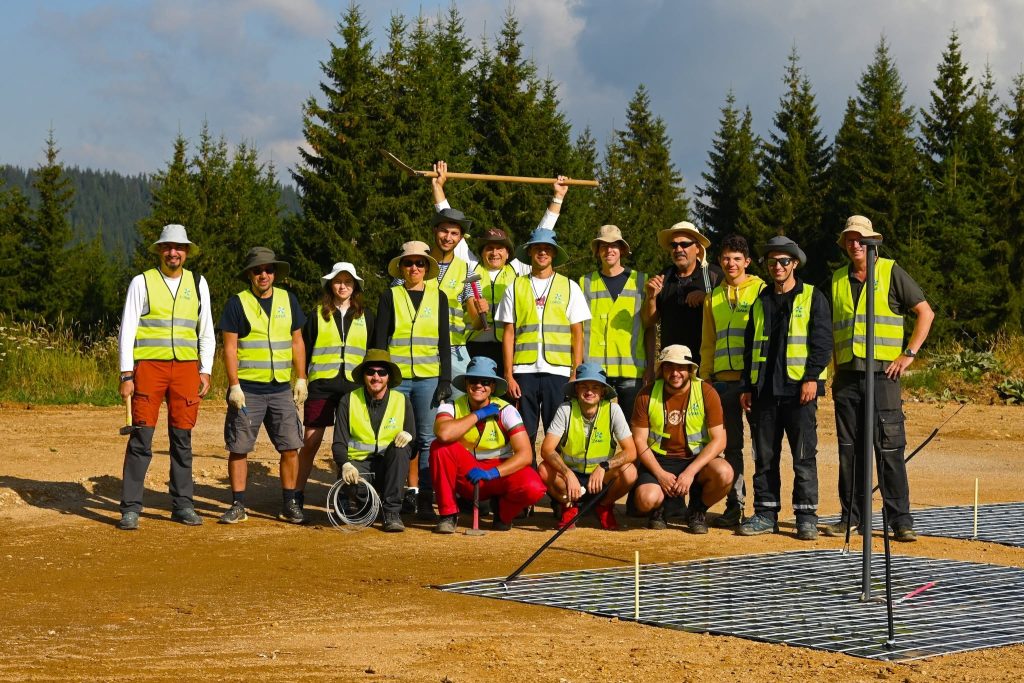 Participants in the LOFAR-BG internship after completing the station’s low-frequency antenna field. Photo: Yanko Nikolov
The rollout of the station was led by a team of experienced engineers and technicians from ASTRON, contracted by AstroTec Holding, with the active participation of over 25 students, PhD students and young researchers, in the summer of 2026 as part of a special radio astronomy internship. It was the interns who carried out the bulk of the work involved in installing the hundreds of low-frequency and high-frequency antennas on site, with the majority of the tasks being carried out by hand.
“We are delighted with the successful completion of the LOFAR-BG station and the strong international collaboration that made it possible,” said prof. Kamen Kozarev, Director of IANAO and coordinator of the LOFAR-BG national consortium. “Once fully operational, it will offer Bulgarian scientists the opportunity for research in various fields of astronomy, space physics, and geophysics.” The project also envisages the development of technological capacity to process petabytes of data using artificial intelligence methods, training for the next generation of scientists to use the telescope, as well as the expansion of the consortium with new partners.
The LOFAR-BG project is funded under the National Roadmap for Scientific Infrastructure 2020–2027, coordinated by the Ministry of Education and Science, Republic of Bulgaria. The national consortium includes IANAO, the Technical University of Sofia, Sofia University St. Kliment Ohridski and University of Shumen “Konstantin Preslavsky”. Bulgaria is a founding member of LOFAR ERIC.